MQTTEye 26 — see what's
going through the broker.
Find brokers on the network, all topics as a tree with last value, history and chart, publish, record and replay messages — for MQTT 3.1, 3.1.1 and 5.0.
MQTTEye 26 connects to one or several brokers at once via TCP, TLS or WebSocket, shows JSON indented, numbers as a chart and binary data as a hex dump, and compares every message with its previous value. No broker yet? MQTTEye starts one itself — for testing devices.
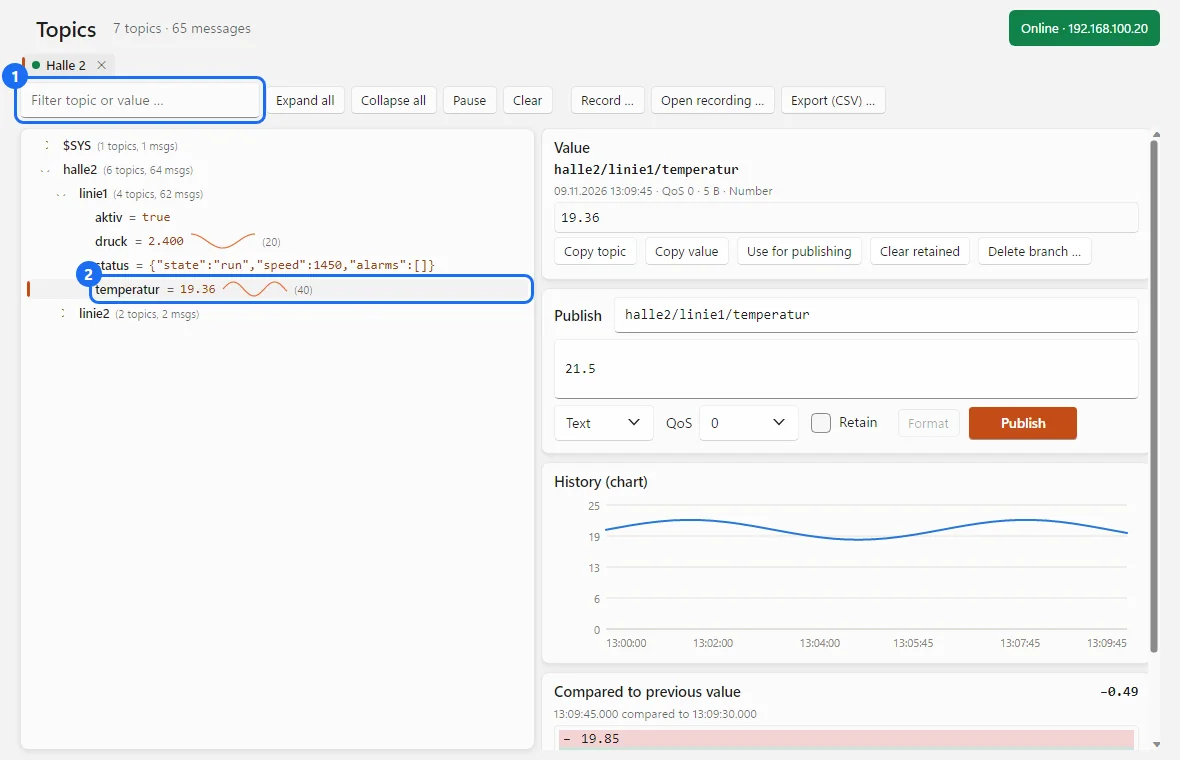
Topic tree with last value and trend curve; on the right value, publish and chart of the selected topic. (Image from the program, sample data.)
From broker scan to replay
For commissioning engineers, system integrators and developers working with MQTT brokers and devices.
Find brokers on the network
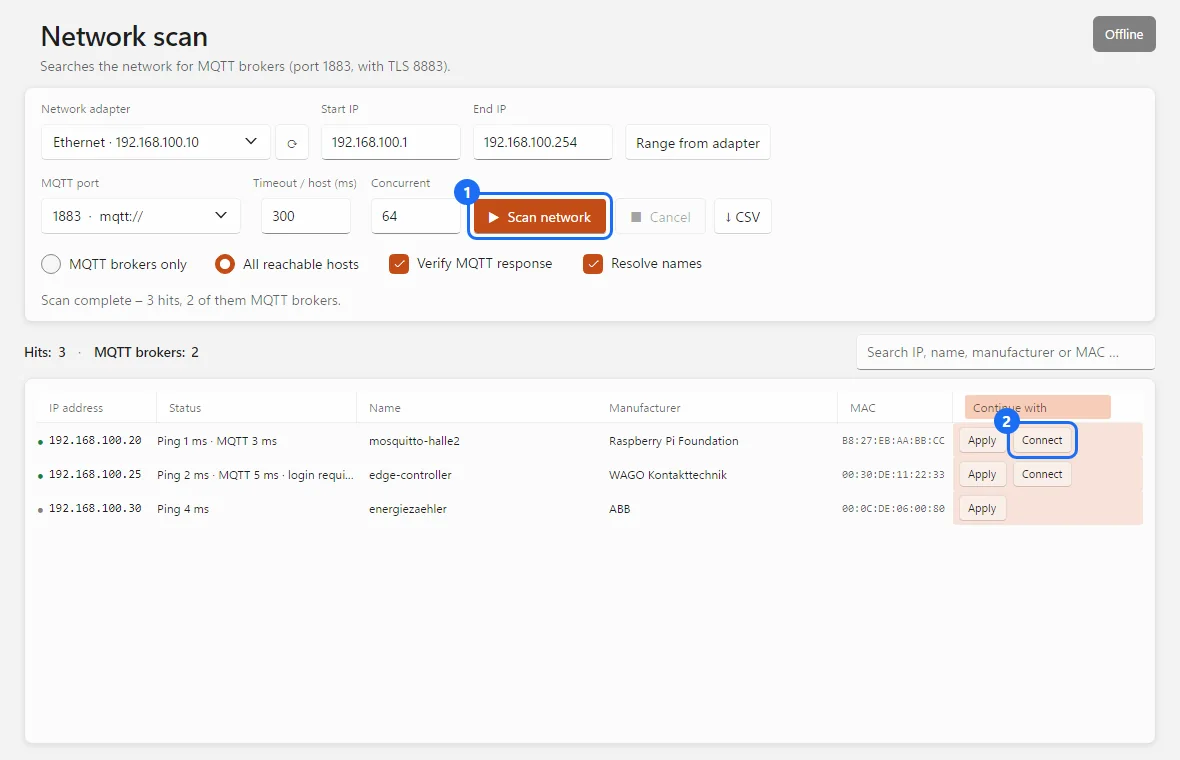
The network scan checks an IP range on port 1883, 8883 (TLS) or a custom port and, on request, logs in via MQTT: “MQTT” only appears for real brokers, “login required” if credentials are needed. Plus name, MAC address and manufacturer.
Topic tree with counters
Every topic level is a node with its last value; branches show the number of topics and messages below — so you find busy areas even when collapsed. Filter by topic and value; “Pause” freezes the tree.
Understand the values
JSON indented, numbers and true/false as a chart, binary data as a hex dump, with MQTT 5 also content type and user properties. The comparison with the previous value shows what changed — line by line for JSON, the difference for numbers.
Publish and clean up
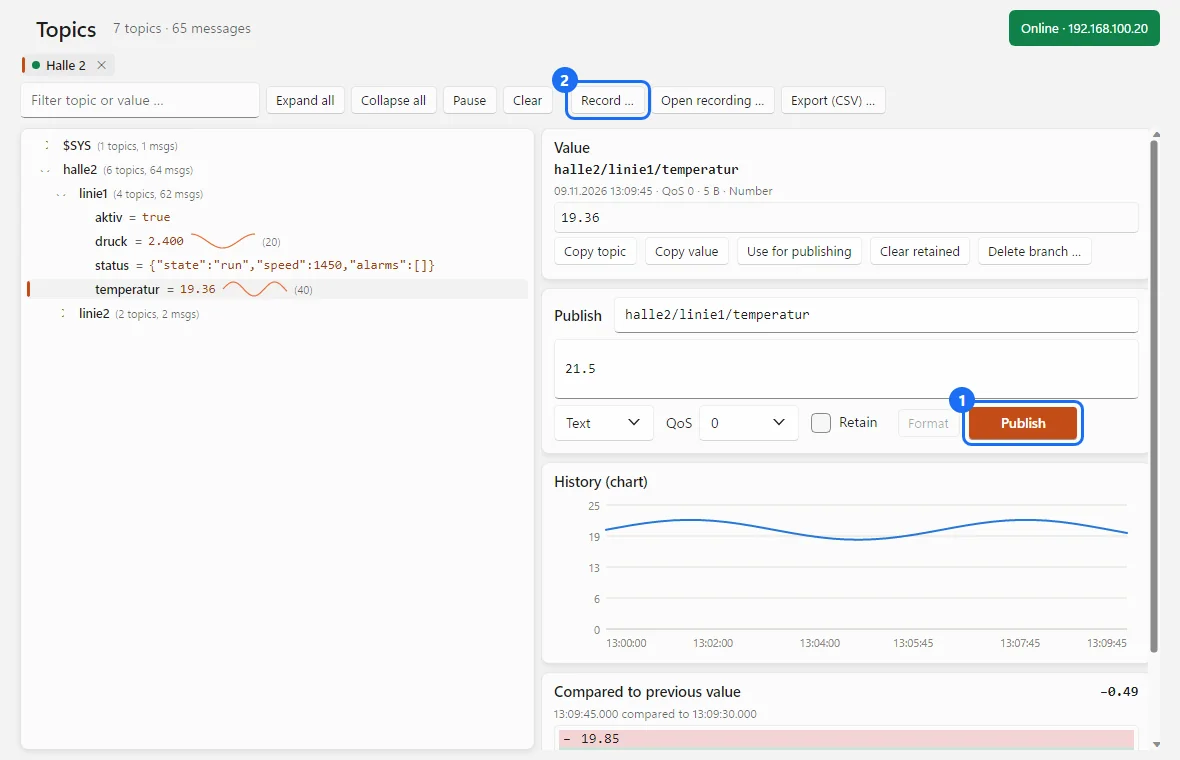
Publish text, JSON or XML — JSON and XML are validated first and can be indented. QoS and retain selectable. Delete retained messages one by one or as a whole branch.
Several brokers at once
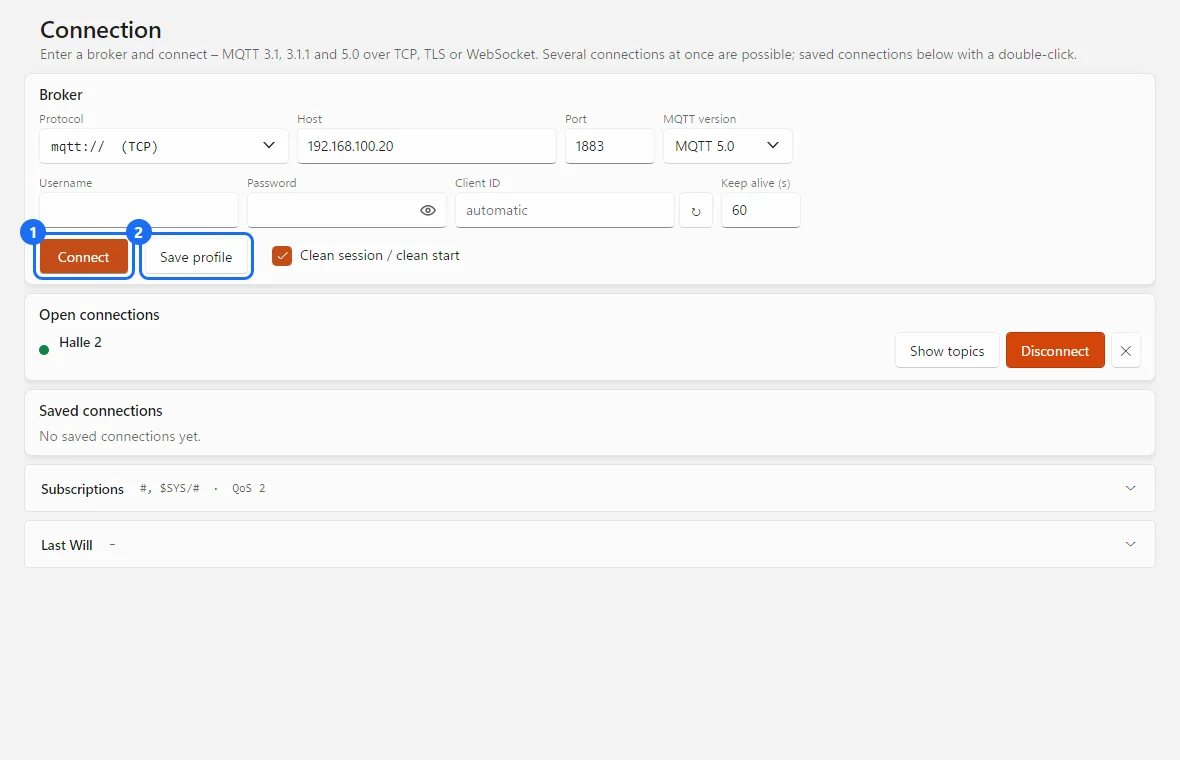
Every connection gets its own tab with its own tree. Save connection profiles — a double-click on a profile connects right away.
TLS and certificates
mqtts:// and wss://, verification against the broker's own CA, client certificates as PFX/P12 or PEM — on Windows also straight from the certificate store. Last will with MQTT 5 properties.
Record and replay
Record all messages as JSON Lines, view them later just like live or replay them to a broker — at the original speed or faster, optionally just one branch and with a topic prefix. Export topics as CSV.
Built-in broker
MQTTEye as a broker over TCP and/or TLS, with a self-signed or your own certificate, optionally with a login. Connected clients with their subscriptions; “Kick” triggers the last will. That way devices can be tested against MQTTEye.
Also: quick tour on first start · light/dark · 19 languages · automatic updates · works with the Eye Suite 26
Your MQTT data in four steps
MQTTEye shows the same steps itself on first start.
Protocols, connections, formats
| MQTT | 3.1 · 3.1.1 · 5.0 |
| Connection | TCP (mqtt://, port 1883), TLS (mqtts://, port 8883), WebSocket (ws:// and wss://) |
| Security | User and password, the broker's own CA, client certificate as PFX/P12 or PEM, on Windows from the certificate store |
| Publish | Text, JSON, XML · QoS 0, 1, 2 · retain · with MQTT 5 including content type |
| Last Will | yes, with MQTT 5 including delay, expiry and content type |
| Recording | JSON Lines (one message per line, binary data as Base64), replay to a broker |
| Export | Topics as CSV |
| Built-in broker | TCP and/or TLS, optionally with login; retained messages and sessions in memory |
Six typical jobs
Commissioning
Check that devices publish the right values on the right topics, and publish values deliberately — with the topic of the selected entry already in the publish field.
Sort out the connection
The network scan shows where a broker answers and whether it requires a login. MQTTEye reports rejected credentials and TLS errors with the reason.
Test devices without the site broker
The built-in broker is the counterpart on your desk. Kick a client to see whether its last will arrives correctly.
Clean up
Remove old retained messages from the broker one by one or as a whole branch.
Reproduce sequences
Replay a recording to a broker — with a topic prefix such as “replay/” so that real devices do not react.
Documentation
Export topics as CSV for Excel, pass on recordings and open them again later.
Try first, license later
Download MQTTEye 26 and request a free trial licence. The licence is activated right in the program.
- Windows: a single program file
- Linux x64 and arm64 (Raspberry Pi)
- The program installs updates itself on request
- Free, all features
- Request online, activate in the program
- Annual licence for one computer, 12-month term
- All features, all 19 languages
- Updates included during the term
- Activation right in the program
For a licence, please write to us at info@busbaer.de. The licence is tied to one computer; if you change computers, please get in touch. You receive the licence code by e-mail and activate it right in the program.

Part of the Eye Suite 26
All Eye tools fit into the free Eye Suite 26: once it is installed, its dashboard shows the licence status of MQTTEye 26, and the traffic also appears in the suite's combined monitor — together with KNX, Modbus and the other protocols. Without the suite, MQTTEye 26 works just the same.
On Windows, MQTTEye 26 asks once on first start whether it should install itself to C:\Program Files\Alexander Maier GmbH\MQTTEye 26\, and creates shortcuts on the desktop and in the Start menu. This needs administrator rights once; later updates run without them.
Windows, Linux and Raspberry Pi
| Windows | 64-bit |
| Linux | 64-bit: x64 for PCs, arm64 e.g. for Raspberry Pi 4 or 5 with Raspberry Pi OS 64-bit (Bookworm or later) and desktop. 32-bit systems are not supported. |
| Installation | Windows: a single program file, .NET included; on first start the program offers to install itself to C:\Program Files\Alexander Maier GmbH\.Linux: tar xzf MQTTEye26-linux-<arch>.tar.gz, then run bash install.sh in the unpacked folder — afterwards start it from the menu or with mqtteye26 in a terminal |
| Network | Access to the broker (TCP, TLS or WebSocket); for the built-in broker the firewall must allow the chosen port inbound |
| Internet | for licence activation and updates |
After that, the program updates itself on request. There is no macOS download yet.
Frequently asked questions
Which MQTT versions and connections are supported?
MQTT 3.1, 3.1.1 and 5.0 over TCP (mqtt://), TLS (mqtts://) and WebSocket (ws:// or wss://). Several brokers can be connected at the same time, each in its own tab.
How can I try MQTTEye?
Download the program and request a free trial licence via “Request trial licence” on this page. You activate the code right in the program.
Does MQTTEye find the brokers on the network?
Yes. The network scan checks an IP range by ping and on the MQTT port (1883, 8883 for TLS or a custom port). With “Check MQTT response”, MQTTEye sends an MQTT login and disconnects straight away — so “MQTT” only appears for real brokers, with the note “login required” if the broker does not accept anonymous connections. Brokers that can only be reached via WebSocket are not detected by the scan.
Why does MQTTEye subscribe with QoS 2 by default?
The broker delivers a message with the lower of the publish QoS and the subscription QoS. With QoS 2 in the subscription you therefore see which QoS a device actually publishes with. The subscription QoS can be selected in the connection form.
How do I delete retained messages?
“Clear retained” sends an empty message with the retain flag; the broker then removes the stored message. “Delete branch” does this for a topic and all topics below it — either only for those whose message arrived as retained, or for all of them.
Can MQTTEye act as a broker itself?
Yes. On the “Broker” page a built-in MQTT broker starts over TCP and/or TLS, with a self-signed or your own certificate and optionally with a login. You see the connected clients with their subscriptions and can kick a client — which triggers its last will. The built-in broker keeps retained messages and sessions in memory only; it does not offer WebSocket.
How do I work with certificates?
For brokers with their own or a self-signed certificate, you specify the broker's CA certificate — verification continues, just against this CA. MQTTEye accepts client certificates as PFX/P12 with a password or as PEM with a key file; on Windows also straight from the certificate store, without a file or password.
Are passwords stored?
Yes, encrypted — on Windows via DPAPI for the signed-in user. On another PC or under another user they cannot be read and have to be entered again.
Can I record messages and replay them later?
Yes. “Record …” writes all messages of a connection to a file as JSON Lines. “Open recording …” shows it later just like live, only without a broker. From the opened recording, “Send to broker …” replays the messages to a connected broker — at the original speed, faster or without pauses, optionally just one branch and with a topic prefix so that real devices do not react.
Does MQTTEye run on Linux or Mac?
Linux yes: packages for x64 and arm64, also for the Raspberry Pi 4 or 5 with Raspberry Pi OS 64-bit. There is no download for macOS yet.
Do I have to install anything?
On Windows, MQTTEye is a single program file. On first start it asks once whether it should install itself to “C:\Program Files\Alexander Maier GmbH\MQTTEye 26\” and creates shortcuts; this needs administrator rights once. On Linux you unpack the archive and run install.sh.
Can I transfer the licence to another computer?
The licence is tied to one computer. If you change computers, please get in touch with us.
What does MQTTEye have to do with the Eye Suite 26?
If the free Eye Suite 26 is installed, its dashboard shows the licence status of MQTTEye 26, and received and sent MQTT messages also appear in the suite's combined monitor. Without the suite, MQTTEye works unchanged.
Which languages are available?
The user interface is available in 19 languages.
Another question? Write to us at info@busbaer.de.
See what's going through the broker.
Download MQTTEye26.exe, request a trial licence — and see your first topic tree within minutes.
Get in touch
Imprint
Alexander Maier GmbH
Beckstraße 3
D-69412 Eberbach
Managing director: Alexander Maier
Registered office: Eberbach
Register court: Mannheim
Commercial register: HRB 335404
VAT ID: DE177682654
Phone: +49 (0) 6271 – 91 94 70
E-Mail: info@busbaer.de