Every charge point, optimally supplied.
Without a single fuse tripping.
The EisBär DLM Controller distributes available power phase-accurately across any number of charge points — statically at the grid connection or dynamically alongside building load, PV and storage. Vendor-independent, local, no ongoing costs.
 Dynamic load management
–□✕
Dynamic load management
–□✕
Live simulation: four 22 kW charge points on a 63 A grid connection, vehicles charging at 11 or 22 kW. Switchable between a fixed setpoint (32 A, no meter required) and doubly dynamic control with metering at the feed-in — including the grid operator's §14a command.
Built for real-world charging parks
From an underground car park with six charge points to a property with thousands — one system that grows with you.
100% local
With EisBär's LNOT™ (Local Network of Things), the solution runs directly on site — stable and without cloud dependency.
Vendor-independent
Any wallbox, AC/DC/HighPower charge point and meter — as long as it speaks OCPP, Modbus, CAN, MQTT, KNX or OPC UA.
Cascades without limit
Base unit with 6 charge points, expandable in steps of 6 up to 40 — beyond that, cascading scales to 1000+ charge points.
No ongoing costs
Local OCPP backend incl. proxy function forwarding to external billing systems — no license fees during operation.
Not a wallbox solution — an open platform
The real decision isn't between two DLM products, but between two fundamentally different architectures: local, open energy and charging infrastructure — or a more prescriptive, often cloud- and vendor-bound solution.
No vendor lock-in
EisBär is deliberately designed so no dependency on a single manufacturer arises. The operator always remains free to choose:
- Charge point manufacturers
- Backend and billing systems
- Operating models — local, hybrid or external
Backend, billing or charge points can be switched later — without replacing the charging infrastructure, losing data, breaking the system, or reinvesting in the base platform. That protects the investment over the entire lifetime of the charging park.
OCPP client for virtual charge points
A built-in OCPP client represents charge points without native OCPP support as virtual OCPP charge points — including older, proprietary devices, or those connected via Modbus, BACnet, KNX or OPC UA.
- EisBär handles the protocol translation
- Full integration into dynamic load management
- Optional forwarding to external backends
Existing charge points don't need to be replaced — investments are preserved, regardless of age or manufacturer.
Everything a charging park needs
Protection, energy sources, tariffs and access — brought together in one system.
Phase-accurate protection
Measurement and control per phase in mA resolution, calculation interval from 1 second. Protects fuses of individual charging clusters up to the entire property.
PV, storage & surplus charging
Any number of generators can be integrated — PV, battery storage, fuel cell or micro wind. Freely configurable how much additional grid energy may be used.
§14a EnWG & peak load
Power reduction per §14a EnWG, also via IEC 60870 — implemented locally at building and charging-infrastructure level, not as a black box in the cloud. The optional demand monitor (15-min measurement) avoids expensive load peaks at the grid connection.
Priority & calendar
Priority via RFID card or charge point, releases and reservations via calendar — including Microsoft Exchange integration.
Dynamic electricity prices
Connection to the day-ahead electricity market: charging starts automatically once the price falls below a configurable threshold.
Fail-safe & redundant
On communication loss, the last setpoints and card pre-authorisation stay active in the wallbox. Redundant setup with two controllers is possible.
Static or dynamic — or both
Reserved power is distributed across the charging devices — either as a fixed value or continuously tracked.
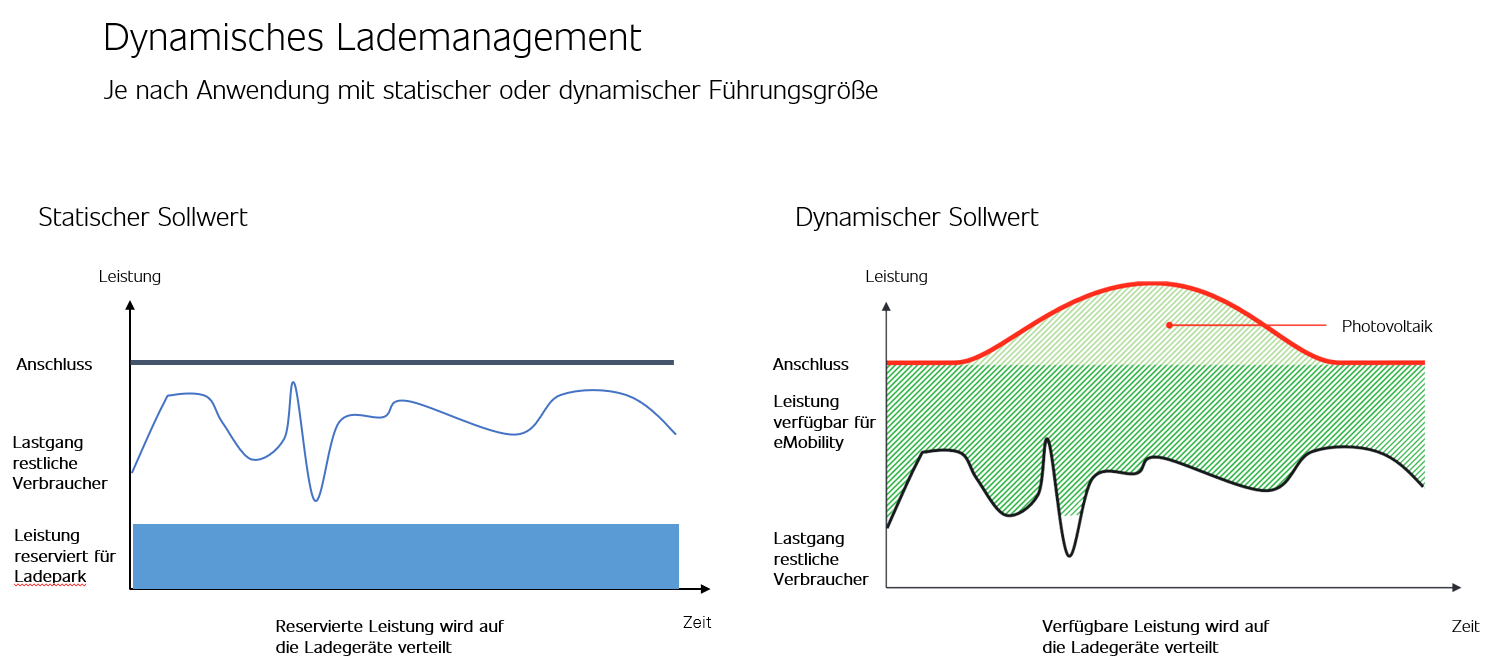
Static
A fixed, defined current value at the charging park's supply point is distributed across all active charge points.
- Reserved power fixed to the connection capacity
- Simple, predictable design without extra metering
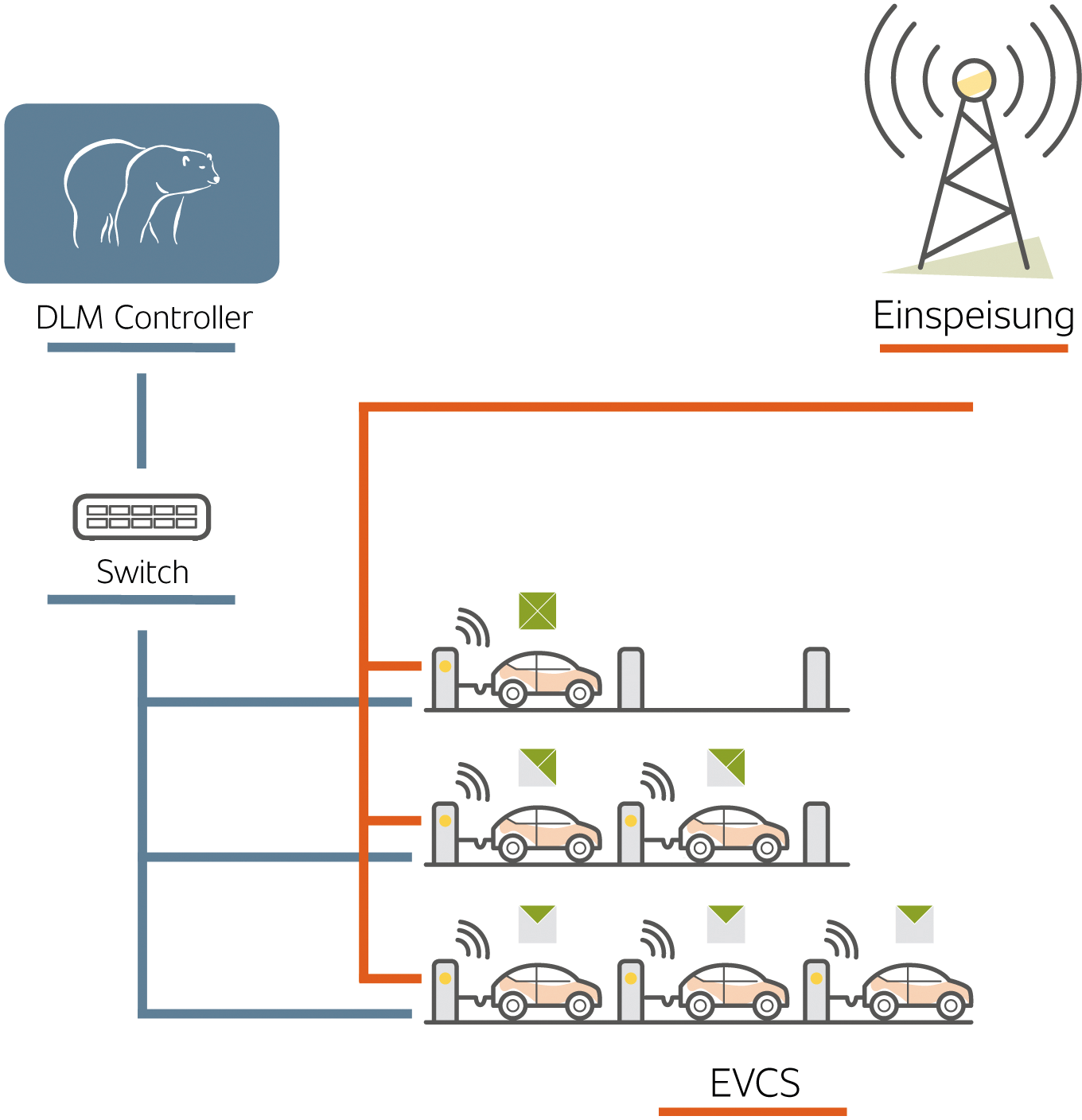
Dynamic
Available power is continuously measured and tracked across grid, PV and storage — “doubly dynamic” control.
- Tracked via power measurement in the building and/or the PV system
- Continuous comparison of assigned vs. actually drawn power — unused power is released immediately and redistributed, even across distribution-board boundaries
- Maximum use of free capacity, including surplus charging
From a single device to an entire property
One internal software module manages up to 1000 charge points. These modules can be cascaded to any depth.
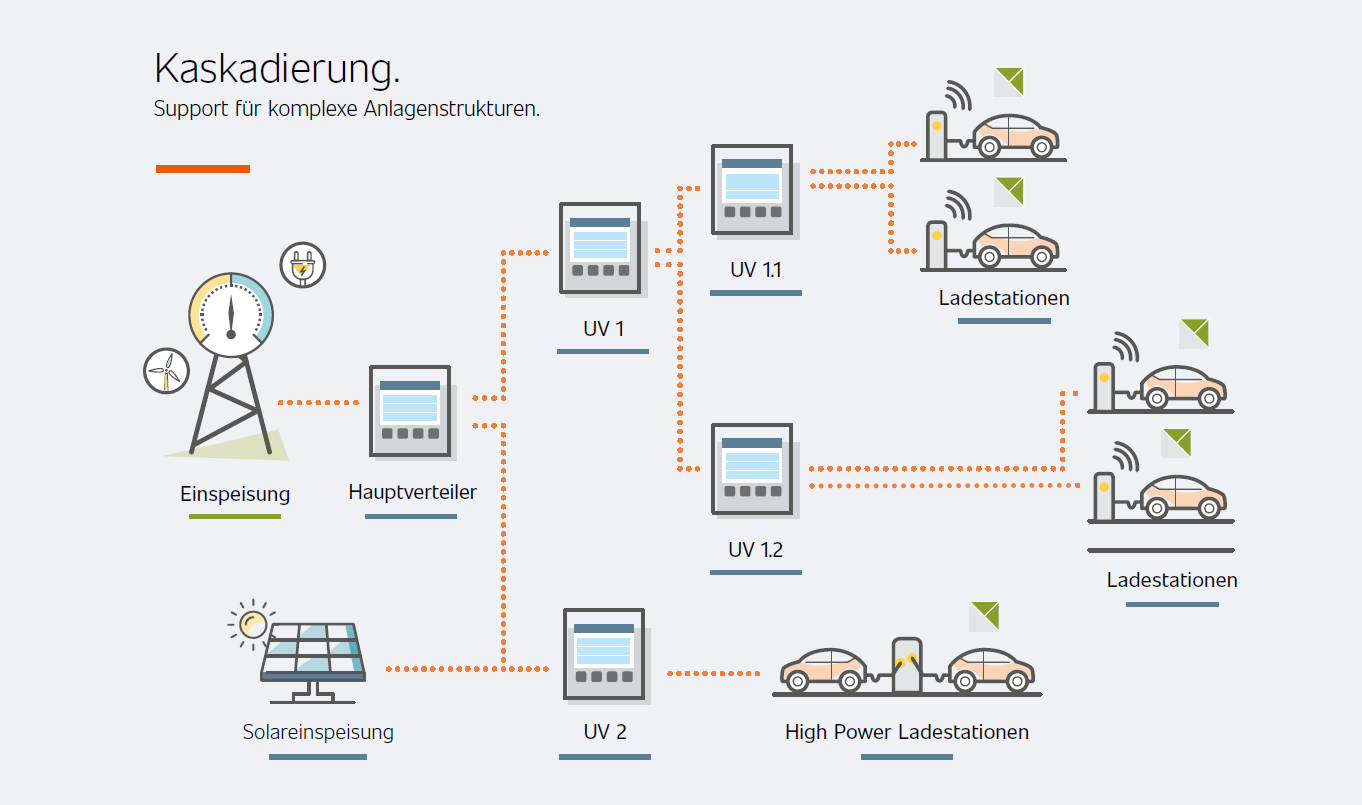
- DLM Controller 6 — base unit with 6 charge points
- Expandable in steps of 6 up to 40 charge points per controller
- Beyond that: software licensing model (EisBär dongle, Architect/Enterprise) with cascaded modules up to 1000+ charge points
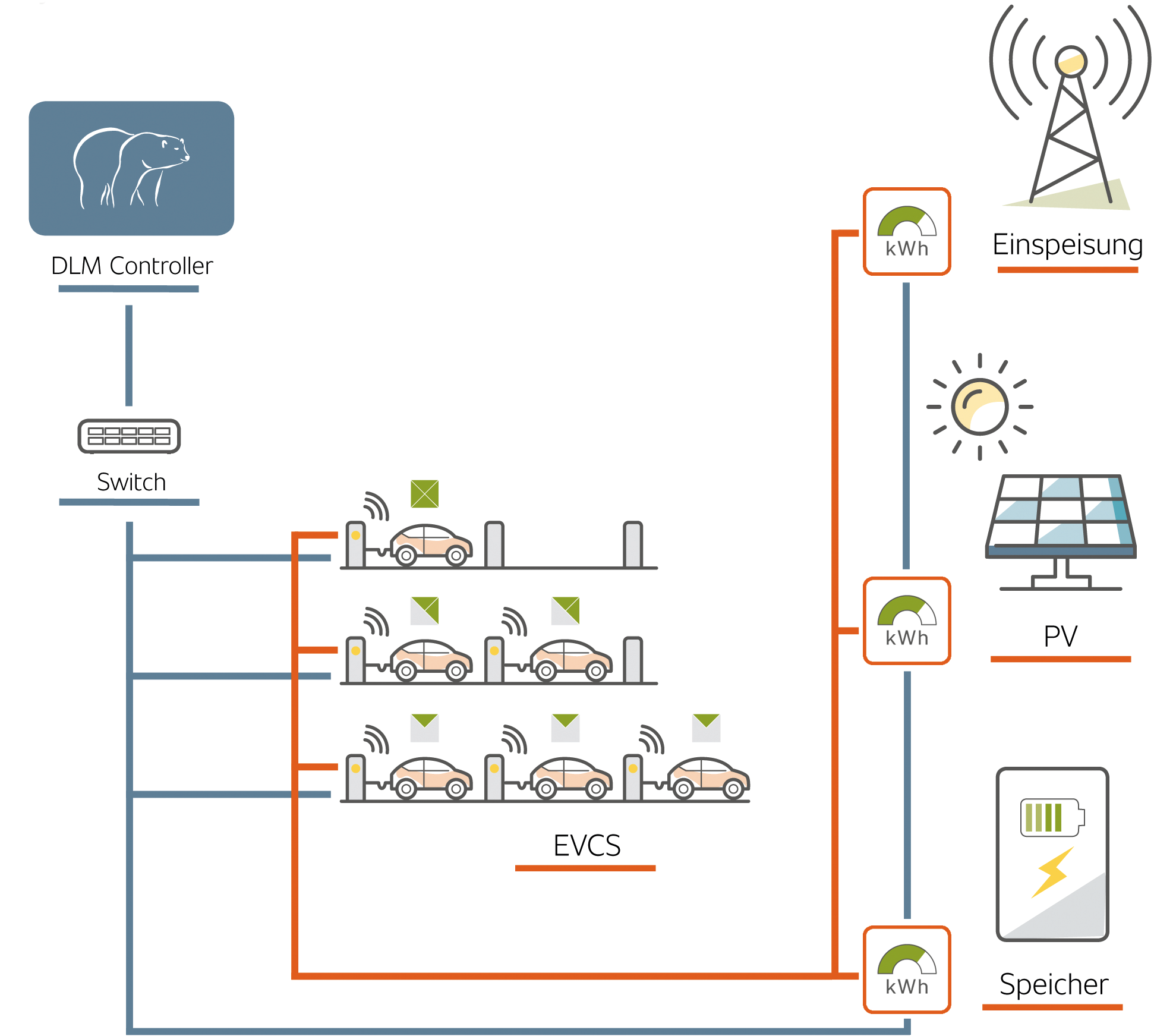
Star-topology wiring, cleanly documented
A typical setup sketch for network and Modbus wiring — from the grid connection through the DLM Controller to every single wallbox.
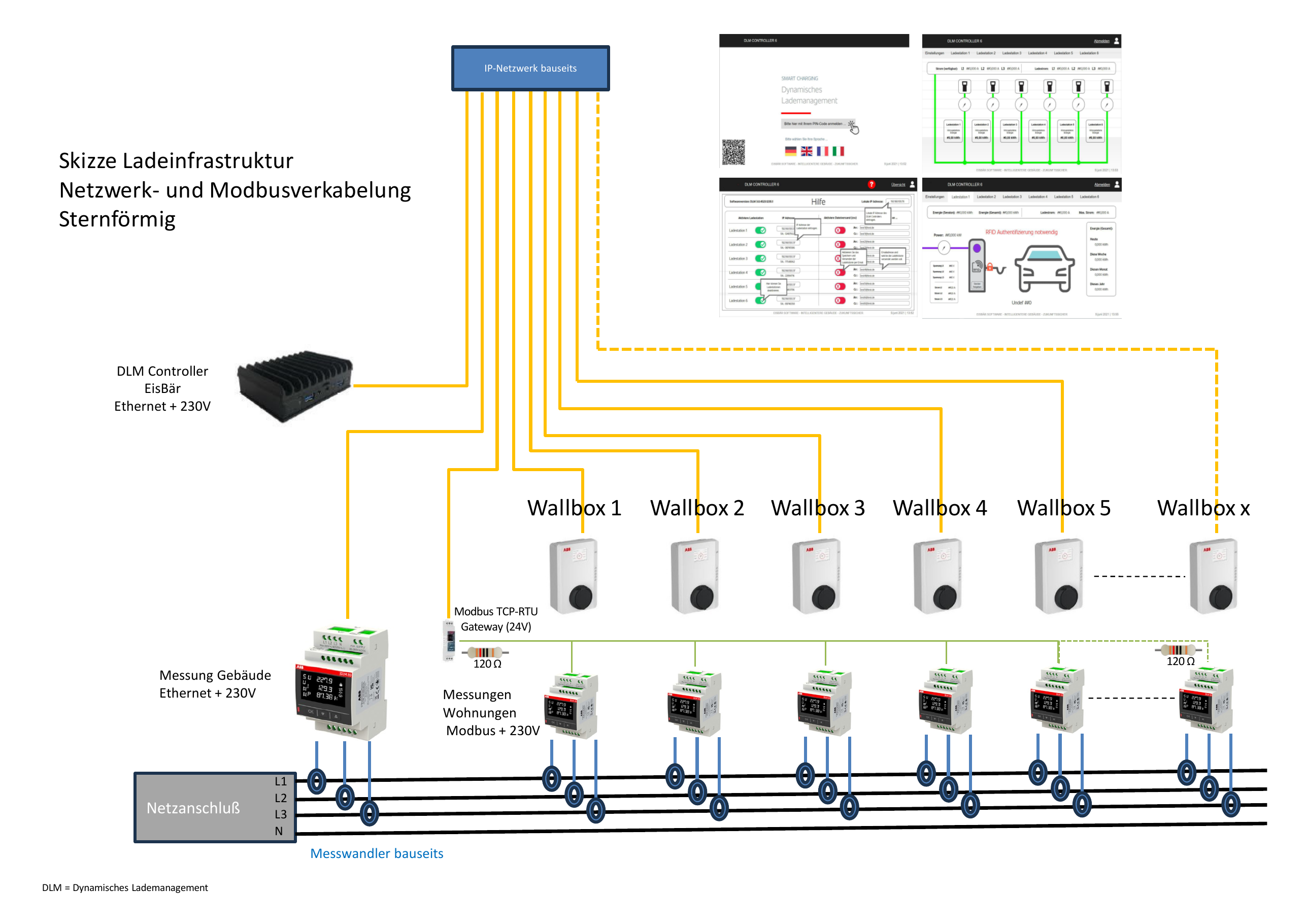
- Wired star-shaped: every wallbox individually via Ethernet + 230 V at the DLM Controller
- Modbus RTU bus for apartment meters, bridged into the IP network via a TCP-RTU gateway
- Current transformers at the grid connection (L1/L2/L3/N) capture the building load on site
Matched to the metering and distribution structure
Three common topologies for multi-party properties — depending on existing metering and distribution equipment.
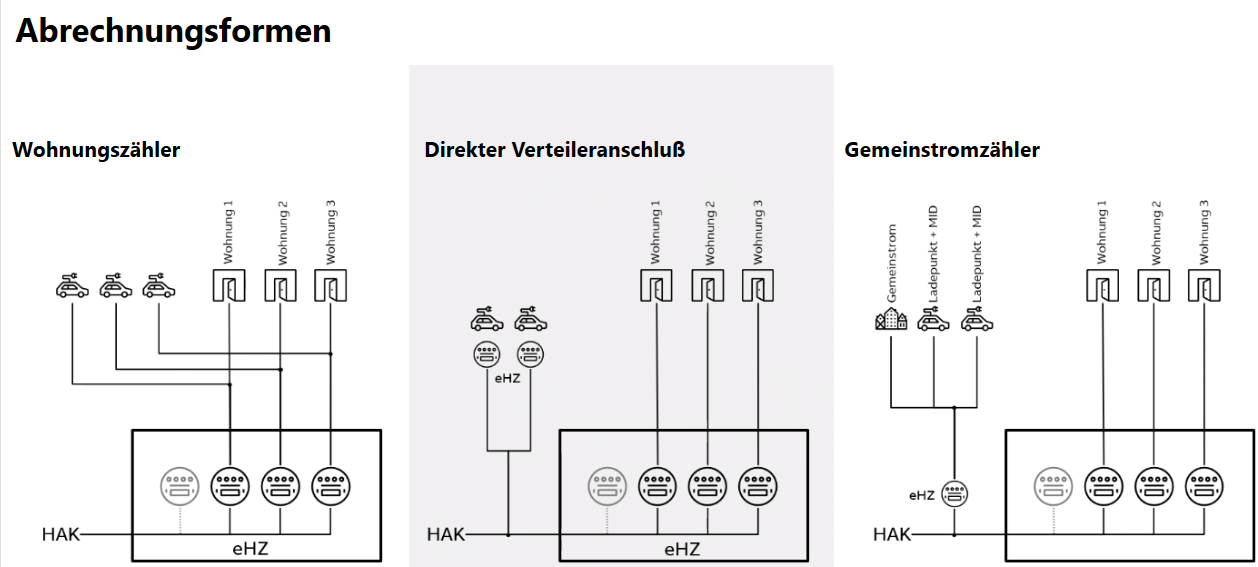
Apartment meter
Charging is metered through each apartment's own meter — billing runs through the existing tenant meter.
Direct distribution connection
Charge points connect directly at the distribution board, measured upstream of the apartment meters — separate from apartment billing.
Shared meter
Charge points run via MID metering on the property's shared meter — ideal for central operator billing.
Everything from a single source
Backend, logging, management and grid connection — pre-configured in the DLM Controller.
- Local OCPP backend (1.6 + 2.01) incl. OCPP proxy
- No ongoing costs
- Local logging per charge point and per RFID card
- Email notification after charging ends, monthly report to the administrator
- RFID card management, optionally personalised with hologram
- Priority per charge point or RFID card
- Calendar control: release and reservation
- PV charging, storage integration
- §14a throttling, also via IEC 60870
- Vendor- and model-independent — AC, DC and HighPower
- Optional turnkey delivery
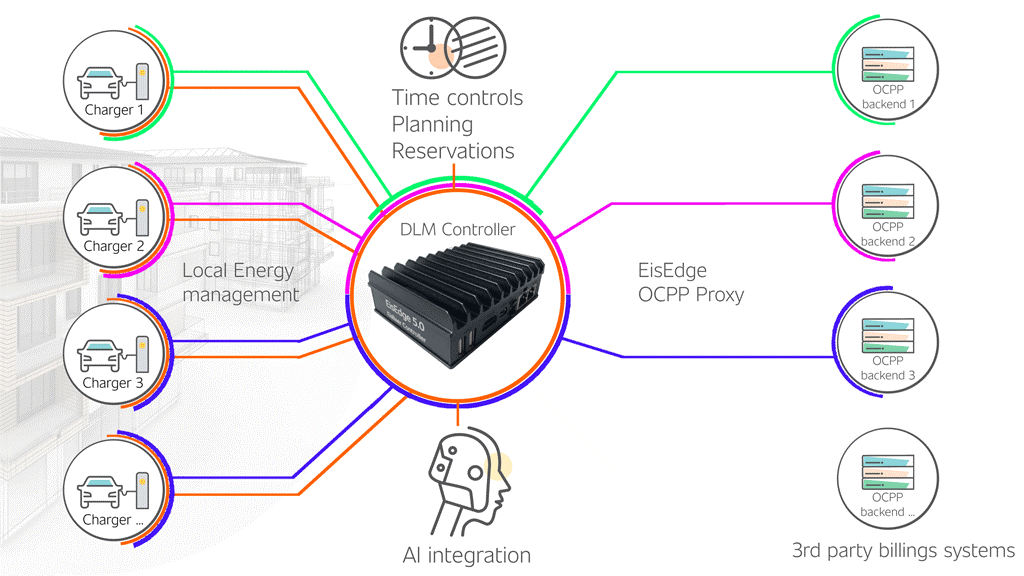
The DLM Controller runs on rugged EisEdge hardware and forwards via the OCPP proxy to one, several or all connected billing backends, as selected.
Open protocols instead of a silo
Wallboxes, meters, storage and upstream backends — connected via standard protocols.
Wherever multiple vehicles charge
From residential buildings to vehicle fleets — at every grid connection with limited capacity.
BAFA-eligible energy management software
Software solution for introducing and maintaining ISO 50001 — energy management software eligible for funding under the guideline of the Federal Ministry for Economic Affairs and Energy, for energy efficiency, control, documentation and automation of buildings and charging parks.
BAFA · Modul 3
Eligible under the Federal Funding for Energy and Resource Efficiency in Industry (EEW), Module 3 – Energy Management Systems, per the guideline of the Federal Ministry for Economic Affairs and Energy (BMWK).
ISO 50001
Supports the introduction and maintenance of an energy management system per ISO 50001 — including documentation of energy-efficiency measures.
Reporting & evidence
Automated evaluations for energy audits and funding applications, including CO2 and savings metrics.
100% local · LNOT™
Runs with EisBär's LNOT™ (Local Network of Things) directly on site — maximum stability and secure local data exchange. No external cloud required, redundant operation possible.
Terms around load management
The key terms, briefly explained.
Charging station (EVCS)
Also called a wallbox or charging pole. AC Type 2 up to 43 kW (typically 11/22 kW), DC CCS up to 360 kW (400/800 V), and HP chargers (High Power).
Charging park
A collection of several charging stations at one location.
Dynamic load management
Continuously reacts to the occupancy and load of the charging stations and redistributes the available power accordingly.
OCPP
Open Charge Point Protocol — an open communication standard between charging station, EV and backend, widely used in the EU and Asia. OCPP 1.6 provides smart-charging functions (MaxProfile); OCPP 2.0 adds cyber security, load regulation and ISO/IEC 15118 (V2G, Plug & Charge).
Backend
Central management system — used primarily to bill charging sessions.
Interfaces to the charging station
The DLM Controller speaks OCPP 1.6, OCPP 2.0, Modbus TCP, Modbus RTU, UDP, OPC UA and CAN.
Frequently asked questions
Answers from bidder questions and project practice — from fuse protection through §14a EnWG to ISO 15118.
Is an OCPP backend built in, and can it forward to an external backend?
Yes. The DLM Controller ships with a local OCPP backend that the wallboxes register with, plus an OCPP proxy function. Individual, several or all boxes can be forwarded to a further external backend, e.g. for billing. Smart charging, authorisation and billing can each be selected to run locally or in the upstream backend.
Which wallboxes and charging systems can be connected?
Any wallbox as well as AC, DC and HighPower charging systems, regardless of manufacturer — as long as one of the protocols OCPP 1.6j, OCPP 2.01j, OPC, Modbus RTU/TCP/UDP, CAN, UDP or MQTT is supported.
Can charge points without native OCPP support be integrated?
Yes. The built-in OCPP client represents such devices — older, proprietary charge points, or those connected via Modbus, BACnet, KNX or OPC UA — as virtual OCPP charge points. EisBär handles the protocol translation and fully integrates them into dynamic load management, with optional forwarding to an external backend. Existing charge points don't need to be replaced.
Can the installation run a mix of private, semi-public and public charge points, and AC together with DC stations?
Yes. Private, semi-public and public operation can be combined within the same installation, as can AC and DC charging stations up to HighPower chargers (e.g. Terra AC with Terra HP) — assignment is made per charge point.
How many charge points can be managed?
As many as needed. One internal software module manages up to 1000 charge points; these modules can be cascaded internally, so a module can in turn drive another 1000, and so on. Integration depth follows the structure of the power supply.
From which OCPP version does smart charging work?
By default from OCPP 1.6 onward. If required, wallboxes with OCPP 1.5 can also be integrated.
Is prioritisation of charging sessions possible?
Yes, by RFID card and/or by wallbox.
How can new RFID cards be enrolled, or blocked cards released again?
Via an Excel table: it holds each card's charge-point permissions, power profile and priority, which is then imported into the system — enrolling a new card or blocking an old one needs no extra software.
Are personalised charge cards available in company branding (CI)?
Yes. Charge cards are supplied in the customer's design, printed in colour on both sides and laminated with a hologram foil.
How is the main building fuse protected?
The integrated dynamic load management limits currents so that fuses and upstream main fuses don't trip — down to individual charging clusters or up to the entire property when cascaded. Measurement and control run per phase at mA resolution, with a calculation interval from 1 second. Independently, an optional peak-load / demand monitor (15-minute measurement) watches the economics of grid draw and can be placed upstream of the load management.
Is current limiting also applied per phase?
Yes, per phase at mA resolution, including phase rotation and, if required, switching off individual phases per wallbox.
What happens if communication to the wallbox fails?
The last set values stay active in the wallbox; depending on the wallbox software, additional fallback settings apply. The same goes for authorisation: card data is distributed to the wallboxes so pre-authorisation or continued charging remains possible even if communication fails.
Are charging sessions logged and evaluated?
Yes. Energy data is written per wallbox and per RFID card into separate Excel files, with a combined overview for the administrator. Users can optionally receive an email summary after each charging session, and the administrator receives all tables at month-end. Current and power readings can also be exported as a CSV strip-chart recording.
Are charging sessions and energy flows shown graphically?
Yes, charging sessions are visualised graphically, with energy flows additionally shown as a Sankey diagram.
Is there an app for control and monitoring?
Yes, for every wallbox via app (Android, iOS or an HTML5 browser client) as well as a Windows client. It shows charging power, maximum charge current, transferred energy and charging status; charging can be started/stopped remotely and the plug unlocked.
Can PV systems, storage and surplus charging be integrated?
Yes. PV systems and battery storage can be integrated via M-Bus, Modbus RTU/TCP/UDP, CAN, KNX or MQTT, along with any number of further generators such as fuel cells or micro wind turbines. The charging park can be adjusted at any time — from surplus charging, where it's freely configurable how much additional energy may be drawn from the grid, to charging exclusively on PV power.
Which meters and measuring devices can be connected?
Any meter, provided it supports one of the following protocols: M-Bus, Modbus RTU/TCP/UDP, CAN, KNX or MQTT.
Can several controllable instantaneous water heaters be integrated?
Yes, as part of an overall concept for multi-family buildings, several controllable instantaneous water heaters can be integrated alongside the charge points.
Can the solution be integrated into building management?
Yes, data can be transferred to higher-level building management systems, including free@home, KNX and BACnet.
Can the solution be procured modularly?
Yes, the EisBär solution can be purchased with individual components or all of them, as required to operate the load management. On-site installation isn't carried out by us directly but can be coordinated with partners on request.
Can pre-configured charging stations be supplied ready to run, for a fee (plug and play)?
Yes, for an additional cost we can supply a fully configured, turnkey installation including the charge points.
Is online support available?
Yes, via remote maintenance directly on the controller — at any time.
Is remote commissioning possible?
Yes, the controller can be commissioned remotely — at a flat rate of €240.
Is time- or calendar-based control possible?
Yes, per charge point and/or per RFID card, including Microsoft Exchange integration for releases and reservations.
Can external signal sources or the grid operator be integrated?
Yes, any external signal source can be integrated. In addition, a bidirectional CIM interface is available for grid/energy operators (EVU).
Does the software meet the criteria required by §14a EnWG?
Yes, §14a EnWG functionality is built in — the grid operator can reduce charging power for grid-support purposes when needed, optionally connected via IEC 60870.
Does the EisBär solution comply with the IEC 60870 standard?
Yes, the connection to the grid operator (EVU) can run over IEC 60870-5-101/-104.
Is calibration-law-compliant billing per PTB (German metrology institute) possible?
Yes, PTB- and calibration-law-compliant metering and billing are supported.
Do billing and tariffs affect the load management?
No, billing and tariffs don't affect the load management itself — that's accounted for in customer billing. Tariffs can, however, influence the power targets of the charging park.
Are there reporting and sustainability metrics?
Yes, reporting functions are available, including a calculation of trees saved, CO2 and similar metrics.
How are faults and events reported?
Using the change-of-value reporting procedure per DIN 19235, including document management plus notification by email, SMS and push.
Is white-labeling possible?
Yes.
How is ISO 15118 / Plug'n Charge supported?
Communication between the backend and the charge points and/or a further backend runs as OCPP Secure over WSS (websocket) and can be encrypted and/or protected by certificate. Bidirectional communication with the vehicle via the wallbox runs over OCPP; all information defined in the 1.6 and 2.0 standards can be transported, including Plug'n Charge.
Is vehicle-to-grid (V2G) possible?
Yes, V2G is possible — the requirements of the hardware used are the deciding factor.
Ready for your charging park?
We advise on sizing, protection and connectivity — from the first charge point to the entire property.
Get in touch
Imprint
Alexander Maier GmbH
Beckstraße 3
D-69412 Eberbach
Managing director: Alexander Maier
Registered office: Eberbach
Register court: Mannheim
Commercial register: HRB 335404
VAT ID: DE177682654
Phone: +49 (0) 6271 – 91 94 70
E-Mail: info@busbaer.de